Baby Carriers and Wraps: What to Buy and What to Skip
A blunt guide to babywearing: the stretchy wrap for newborns, the structured carrier for daily use, and the forward-facing carriers that aren't worth it.

Affiliate disclosure
This guide contains Amazon affiliate links. As an Amazon Associate I earn from qualifying purchases at no extra cost to you. Products are sold by Amazon or its third-party sellers, not by newmomshop.com. Dana's picks reflect independent editorial opinion; brands do not pay for placement or positive coverage. Read the full policy.
Babywearing gets marketed as a bonding philosophy. It’s also just a hands-free way to carry a baby that’s less likely to destroy your back than a car seat in one hand and a diaper bag in the other. Start there.
One caveat before the picks: babywearing is worth learning from a video or a babywearing educator, not just a written guide. Carries look more complicated in text than they are in practice. Most parents get it in one or two tries.
Newborns: a stretchy wrap
The Solly Baby Wrap is the stretchy wrap I’d buy for the newborn phase. The modal fabric is noticeably lighter than a standard jersey wrap — less bulk, better airflow, and it doesn’t feel like wrapping your baby in a thick cotton T-shirt in July. Works from birth to about 25 lbs.
The learning curve is real but short. Watch one video. The first tie is confusing; by the third you’re doing it in the dark. The tradeoff vs. a structured carrier is that a stretchy wrap is one long piece of fabric — quicker to wash, slower to put on, and not something you’ll use on a trail.
4 months and up: a structured carrier
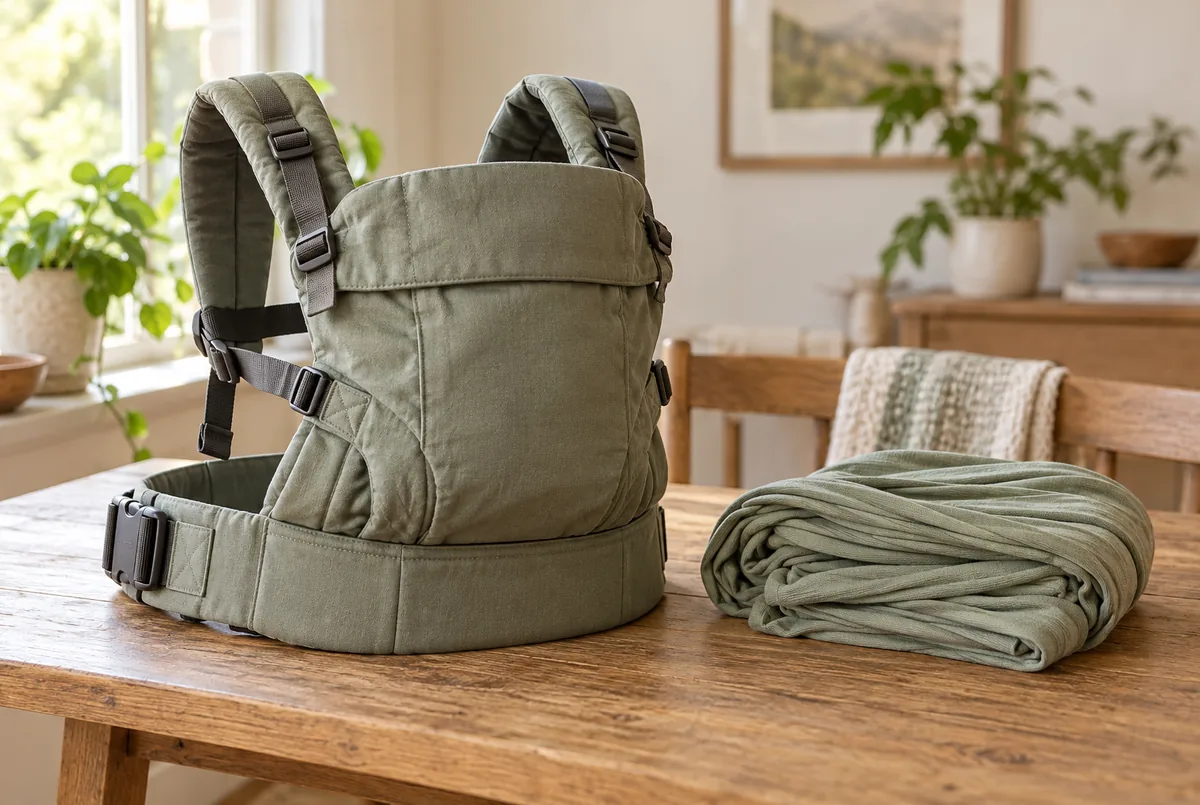
Once the baby has head control and starts getting genuinely heavy, the Ergobaby Omni 360 is what I’d switch to. Waist belt, lumbar support, adjustable back panel — weight distributes across your hips instead of pulling on your shoulders. Newborn insert adds a step for the first few months, but it works, and the carrier carries through toddlerhood (to 45 lbs) so you’re not replacing it.
The key ergonomic requirement: the carrier should hold the baby in the M position — knees at or above hip level, not legs dangling straight down. The Omni 360 does this correctly. This is what pediatricians and every serious carrier manufacturer specify, and it matters for hip development.
Skip: forward-facing carriers with no hip seat
Carriers that put a young baby facing outward with legs dangling — no M-position seat, no lumbar support for the wearer — are not the move. The baby’s hip position is wrong (legs hanging instead of supported), and all the weight ends up on your shoulders. The Björn Original is the classic example of this category, and it’s the one you’ll find the most.
If you want an outward-facing carry for a curious older baby who has good head and trunk control, look for structured carriers that include a forward-facing position with a proper hip seat. The Ergobaby Omni 360 has one. The dangling-legs style is a different thing and worth skipping.
The actual short list
Stretchy wrap for the newborn phase, structured carrier once the baby is heavy and has head control. If you only want to buy one thing, start with the structured carrier and use the newborn insert — you’ll get more months out of it. If you’re expecting a very small baby or a preemie, the stretchy wrap is gentler for early carries.
If you’re building a registry, carriers belong on it. See the registry checklist for where they fit in the priority order.
Solly Baby Wrap
Solly Baby · Available on Amazon
The lightest stretchy wrap in our picks — a single layer of modal fabric that breathes, washes well, and does not turn into a full-body wrestling match to put on. Works from birth to about 25 lbs.
- Modal fabric is significantly lighter and softer than jersey wraps
- One-size, no buckles or rings to fumble with
- Machine washable
- Learning curve for the first few wears — watch a video
- Not great for hiking or extended outdoor use (fabric is lightweight, not structured)
Omni 360 Baby Carrier
Ergobaby · Available on Amazon
A carrier that works well once a baby has head control. Buckles on and off fast, distributes weight across both hips and shoulders, and carries through toddlerhood. Newborn insert adds cost but works.
- Works facing-in newborn through toddler (up to 45 lbs)
- Full lumbar support — the back panel extends as baby grows
- Front, back, and hip carry positions
- Newborn insert sold separately ($30) is required under 4 months
- Bulkier to pack than a stretchy wrap
Forward-facing carriers without hip-seat support
various
Carriers that put baby facing out with dangling legs — no M-position hip seat, no lumbar support for the wearer. Reputable carrier manufacturers and most pediatricians specify knees-higher-than-hips for hip development. Skip them.
- Dangling-legs position not supported by reputable ergonomic carrier manufacturers' guidelines
- No lumbar support transfers all weight to wearer's shoulders
- Baby facing outward is overstimulating for extended carries in early months
Questions parents ask before buying
What's the difference between a stretchy wrap and a structured carrier?
A stretchy wrap (like a Solly or Moby) is a long piece of fabric you tie around yourself — lower learning curve for newborns, lighter and softer, but not ideal once the baby gets heavy. A structured carrier (like an Ergobaby) has buckles and a waist belt, goes on and off faster, and supports more weight. Most parents end up with one of each.
When should I switch from a stretchy wrap to a structured carrier?
Typically around 4–5 months, once the baby has decent head control and is getting too heavy for a single-layer wrap to feel comfortable. Some parents make the switch earlier, some stay in the wrap longer — it depends on the baby's size and your back.
Are ring slings good for newborns?
Ring slings work for newborns but have a steeper learning curve than a stretchy wrap. If you want to try babywearing and have never done it before, start with a stretchy wrap for the newborn phase. If you're already experienced, a ring sling is a lighter, faster option.
Is the ergonomic (M-position) thing really necessary?
It's what every reputable carrier manufacturer specifies and what pediatricians echo for hip development. The short version: knees should be at or above hip level, forming an M shape when you look at the baby from the front. Avoid carriers that let legs dangle straight down.